
If you’re running a private equity, venture, credit, or other alternative-investment fund, your limited partners have one consistent request: they want to see their capital account, their distributions, their K-1s, and the fund’s performance — without having to email your IR team for every piece of paper.
An LP portal (sometimes called a private equity investor portal or LP investor portal) gives limited partners secure, real-time, self-service access to the documents and data they care about. It’s the modern replacement for quarterly PDF emails and the “can you re-send my K-1?” inbox.
This page covers LP portals specifically — for the broader category, see our investor portals overview. For the real estate specialty, see real estate investor portals.
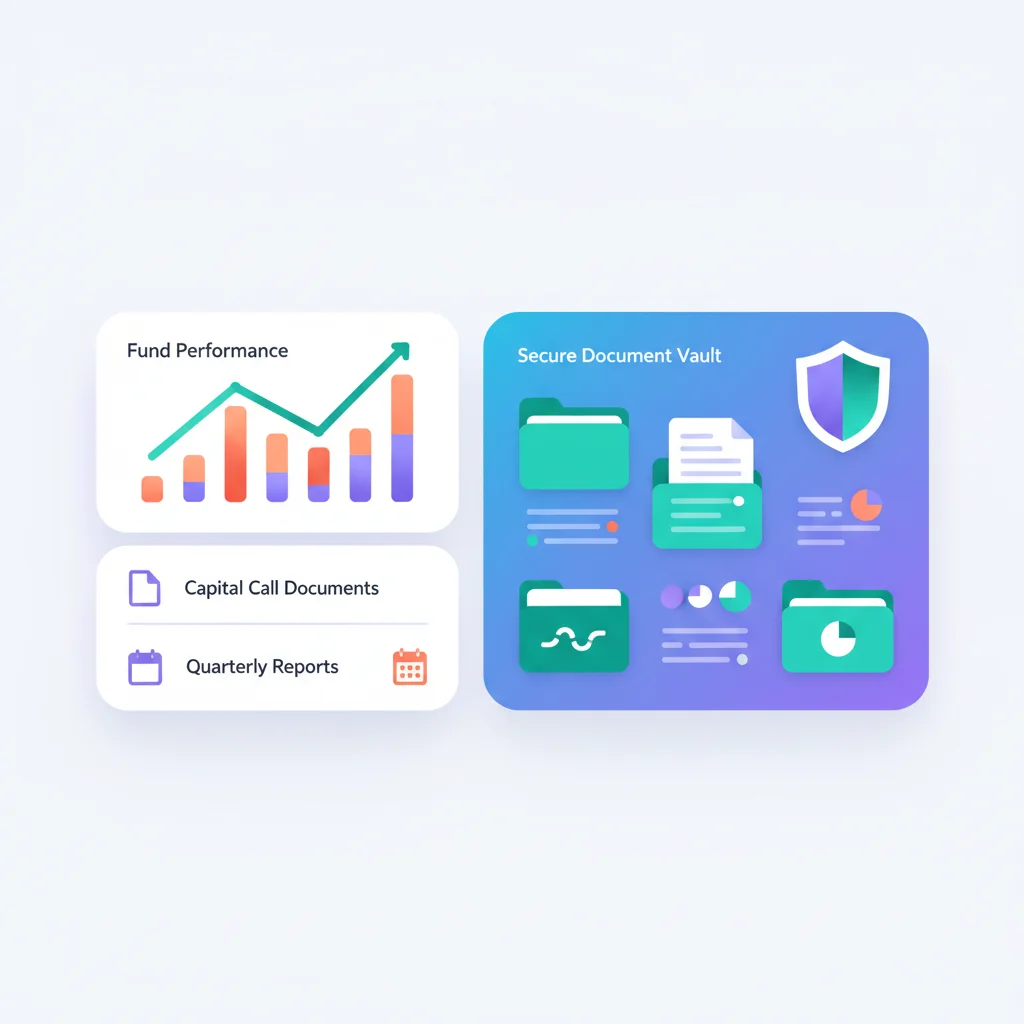
What LPs Actually Want to See
LPs interact with portals around five recurring questions:
“What’s my capital account look like right now?”
Current capital balance, total commitments, called capital, uncalled commitments, distributions received, unrealized value. An LP portal that surfaces this without an email exchange is the single highest-value feature.
”Where are my K-1s and tax documents?”
K-1s, 1099s, state tax packages, year-end summaries. Tax season is when an LP portal earns its keep. The right portal automates per-LP document gating so each investor sees only their own forms.
”How is the fund performing?”
Fund-level performance: IRR (gross and net), TVPI, DPI, RVPI, benchmark comparisons. Portfolio company summaries for closed-end funds. Position-level transparency varies by fund — your portal should let you control what’s exposed.
”What’s happening with capital calls and distributions?”
Capital call notices, distribution notices, wire instructions, payment status. Notifications that pull LPs back into the portal when something requires their attention.
”Who do I talk to and what was decided?”
Fund updates, IR commentary, annual meeting materials, quarterly letters, advisory committee decisions. A searchable archive replaces “can you forward me the Q3 letter from 2023?”
Core Features of an LP Portal
- Capital account statements — Per-LP financial detail, refreshable on quarter close or live where the GP system supports it.
- Document vault — Subscription documents, side letters, K-1s, capital call notices, distribution notices, audited financials, quarterly letters. Document-level permissions per LP.
- Fund and portfolio performance dashboards — IRR, TVPI, DPI, RVPI, benchmarks, portfolio company performance. Customizable by LP type (anchor LP vs. sleeve LP vs. co-investor often see different views).
- Capital call and distribution workflow — Notice generation, wire instructions, notifications, payment tracking.
- Tax document delivery — K-1 distribution with per-LP gating, with automated workflows around the year-end push.
- Role-based access — Different views for LPs, LP staff (analyst at the endowment), advisory committee members, GPs, and fund admins.
- Single sign-on — Enterprise LPs (pension funds, endowments, sovereign wealth funds) often require SAML SSO into their identity provider.
- Audit trail — Every document access logged. This is increasingly required for institutional investor due diligence.
- Multi-fund access — A single LP across multiple funds (Fund I, Fund II, an Opportunity Fund, a Co-Invest vehicle) sees everything from one login.
LP Portal Software for Private Equity
The market has consolidated into a few category leaders plus several strong specialists.
- Juniper Square — Strong in real estate private equity; expanding into broader alternatives. Comprehensive LP portal with fund admin integration.
- Allvue Systems — Investor portal as part of a broader alternative-investment platform covering portfolio management, fund accounting, and CLO management. Common at larger funds.
- Anduin — Investor onboarding and ongoing LP communications. Particularly strong on subscription documents and KYC/AML workflows.
- Carta — Cap table management with an investor-facing portal. Strong fit for venture funds already using Carta for their portfolio companies.
- Dynamo Software — Investment management CRM with LP portal capabilities. Strong on the front-office and IR side.
- Backstop Solutions — IR and investment management platform with an LP portal. Common at fund-of-funds and institutional allocators.
- Altvia — CRM-led investment management platform with an LP portal built on Salesforce.
- Investran (FIS) — Long-established fund accounting and investor reporting platform used by many large GPs.
- eVestment — Data and IR platform with investor reporting capabilities.
For a venture fund or small PE fund just getting started, Carta and Juniper Square are the most common starting points. As funds scale into multiple vehicles and institutional LP relationships, the choice often moves toward Allvue, Investran, or a custom build on top of fund accounting infrastructure.
What a Private Equity LP Portal Looks Like in Practice
An LP at a small university endowment logs into their portal on a Monday morning to prep for their quarterly investment committee meeting. They see, across the four funds they’re invested in with this GP: current capital balance, this quarter’s mark, IRR vs. last quarter, recent distributions, and upcoming capital calls. They drill into the most recent Fund III quarterly letter, jump to the portfolio company summary for a company that’s been in the news, and download the K-1s their tax team flagged. Total time: about six minutes. The same workflow in 2015 was: open four separate emails, find four separate attached PDFs, manually reconcile to the endowment’s investment system, and email the GP for two missing documents.
The shift isn’t just convenience — it’s institutional credibility. LPs evaluating a new fund commitment will absolutely include the LP portal in their due diligence. A clunky portal or, worse, no portal at all is a small but real negative signal during fundraising. Conversely, a well-designed portal signals operational maturity.
Audit, Compliance, and Security for LP Portals
LPs increasingly treat operational due diligence on the GP’s technology stack as part of the investment decision. Expect questions on:
- SOC 2 Type II of the portal platform.
- Encryption in transit (TLS 1.2+) and at rest (AES-256).
- Audit logging of all document access — including who downloaded each K-1 and when.
- Access control — MFA enforced, SSO supported for institutional LPs, role-based permissions.
- Data residency — Some institutional LPs require US-only or EU-only data storage.
- Backup and disaster recovery — RPO/RTO targets the platform commits to.
See our security best practices guide and portal authentication guide for the underlying patterns.
Frequently Asked Questions
What’s the difference between an LP portal and an investor portal?
An LP portal is a specific kind of investor portal designed for limited partners in funds — private equity, venture, credit, real estate. The terminology emphasizes the GP–LP relationship structure: capital commitments, capital calls, distributions, K-1s. “Investor portal” is the broader umbrella term that also covers public-company investor relations portals, shareholder portals, and direct-deal investor portals.
Do small funds need an LP portal?
If you have institutional LPs (endowments, pension funds, funds-of-funds), yes — increasingly it’s table stakes for fundraising. For funds with only friends-and-family LPs, a shared Drive folder may suffice initially, but most funds outgrow this within their second vehicle.
Can we build an LP portal in-house?
You can — and some larger funds do. The trade-off is that LP-facing software is heavily scrutinized in ODD (operational due diligence), and an in-house build needs to demonstrate the same security, audit, and reliability characteristics that commercial platforms have already certified. Most funds find buying makes more economic sense unless they have unusual requirements. See our build vs. buy guide.
How does an LP portal handle multiple funds and co-investment vehicles?
Modern LP portals support multi-fund access from a single login. An LP in Fund I, Fund II, and a co-investment SPV sees all three in one consolidated view, with separate capital account statements per vehicle. Look for this explicitly — older platforms sometimes require separate logins per fund.
What about secondary transactions?
When an LP sells their interest in a secondary transaction, the portal needs to handle the cap-table change cleanly: transferring document access, capital account history, and ongoing tax document delivery to the new LP. Not all portals do this gracefully — ask about secondary support during evaluation.
What is an LP portal?
An LP portal is a specific type of investor portal designed for limited partners in alternative investment funds — private equity, venture, real estate, credit. The terminology emphasizes the GP–LP relationship structure: capital commitments, capital calls, distributions, K-1s, fund performance. The detailed feature breakdown and software comparison is throughout this page.
What are the 4 P’s of due diligence?
In LP due diligence on a fund manager, the “4 P’s” commonly cited: People (the GP team, their experience, alignment, and stability), Philosophy (the investment strategy and its discipline), Process (how investments are sourced, evaluated, executed, and exited), and Performance (track record, attribution, and consistency). A well-built LP portal supports the operational due diligence (ODD) component by demonstrating security, audit, and process maturity.