
The phrase “investor reporting portal” shows up across very different contexts — a venture fund publishing quarterly capital account statements, an investment manager sharing client reports, a public company’s IR site distributing earnings materials, an alternative asset manager delivering K-1s to LPs. They share a core idea: replace the email a PDF model of investor communication with an interactive, secure, self-service experience.
This article is the deep dive on investor reporting portals specifically — the reporting half of the broader investor portal landscape, with attention to the workflows, KPIs, and software that make reporting actually work.
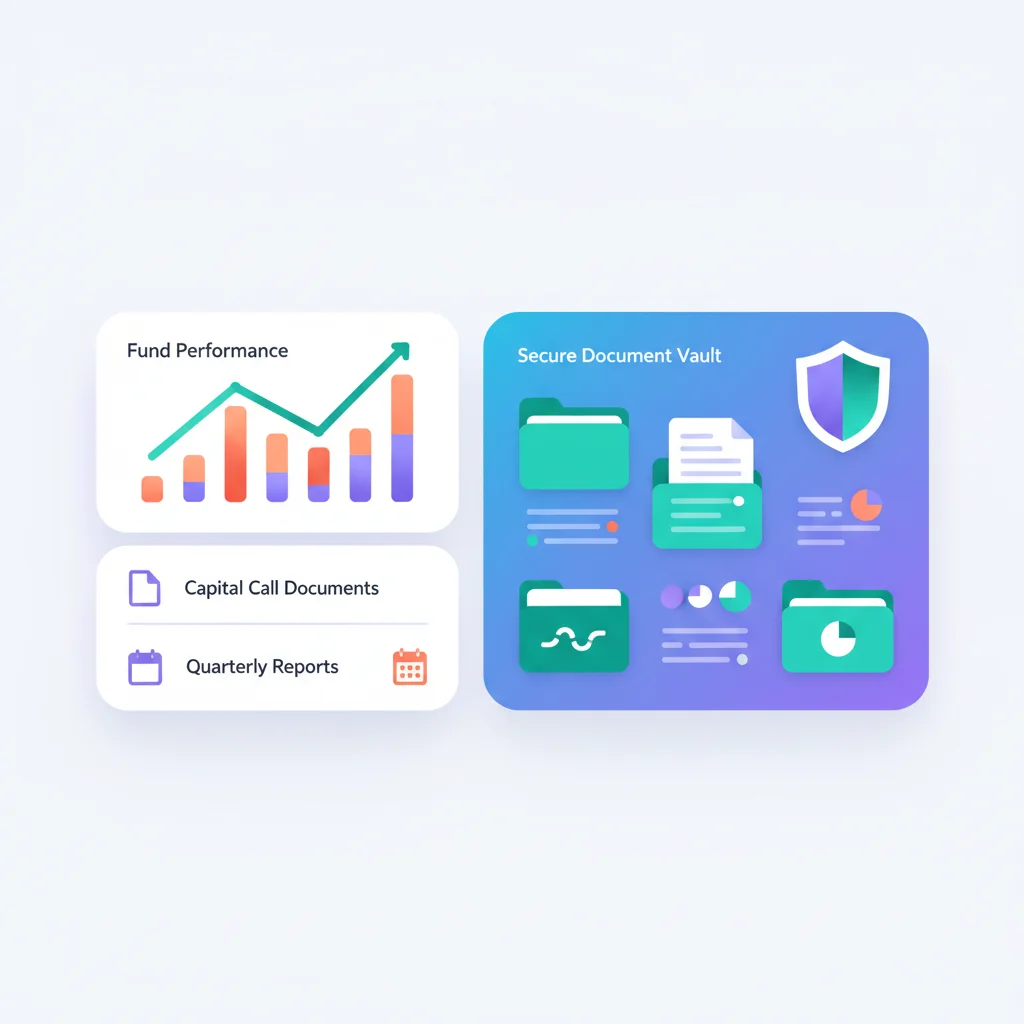
Investment Client Reporting Portal: The Four Audiences
Different audiences need different reporting portals, and conflating them leads to platforms that serve nobody well.
1. Limited partners in alternative funds (PE, VC, real estate, credit)
For LPs, the portal is the system of record for their relationship with the fund. They need capital account statements, fund and portfolio performance, K-1s, capital call notices, distribution notices, and quarterly letters. See our dedicated pages on LP portals and real estate investor portals.
2. Wealth management clients
For individual investors at a wealth management firm or RIA, the portal shows their portfolio across accounts, asset allocation, performance vs. benchmark, recent transactions, and account documents. The relationship is advisor-to-client rather than GP-to-LP, but the reporting infrastructure is similar.
3. Institutional asset management clients
For institutional separately-managed accounts (SMAs), the portal delivers detailed portfolio holdings, performance attribution, compliance reporting, and quarterly review materials. Audience expectation is high; UX expectations are sometimes lower than retail because data depth matters more.
4. Public-company shareholders and analyst community
For listed companies, the “investor reporting portal” is the IR section of their corporate site plus secure data rooms for restricted materials. Audience is broader and less individuated than the others.
The features below apply most directly to the first three — secure, per-investor reporting portals. Public-company IR is a related but distinct discipline.
Core Features of an Investor Reporting Portal
Per-investor data gating
Every investor sees only their own data. This sounds obvious; the engineering required to do it correctly across multiple funds, vehicles, and account types is significant. Document-level permissions, row-level data security, and audit logs of every access all combine here.
Performance reporting
Time-weighted return, money-weighted return, gross vs. net, vs. benchmark, by asset class, by holding, by time period. Different investors care about different cuts — a wealth client may want simple total return vs. S&P, while an institutional LP wants gross IRR, net IRR, TVPI, DPI, and benchmark percentile.
Document delivery and archive
Quarterly letters, audited financials, K-1s, 1099s, capital call notices, distribution notices, regulatory filings. Search and filter across years. Bulk download for tax preparers. Per-document audit log of who accessed what and when.
Capital activity visibility
For LPs: commitments, contributions, distributions, current capital balance, unfunded commitments. For wealth clients: contributions, withdrawals, fees charged, dividend/interest income.
Tax document workflows
The single most important annual event for an investor reporting portal is K-1 / 1099 delivery. The right portal supports: automated per-investor gating, secure delivery with notification, an audit trail of who downloaded their form when, and corrections workflows when forms are amended (which they often are).
Interactive dashboards
Beyond static reports, modern investor portals let investors filter and drill into their data: by date range, by asset class, by vehicle. For LPs in multiple funds, a consolidated dashboard across all vehicles is increasingly expected.
Secure messaging
A way for investors to ask questions and get answers in-context — without those questions and answers ending up in an unsecured email thread. Ties to specific funds/accounts/documents for traceability.
Compliance and audit
Role-based access control, SSO for institutional clients, full audit logging, data residency controls, SOC 2 Type II at the platform level.
Investor Reporting Portal Software
The right platform depends heavily on the audience. A few examples by category:
Alternative investment (PE, VC, RE, credit)
- Juniper Square — Investor portal + fund admin, strongest in real estate but expanding.
- Allvue Systems — Enterprise platform for alternatives covering portfolio management, fund accounting, and investor reporting.
- Carta — Cap table + LP portal for venture funds.
- Anduin — Investor onboarding and communications.
- Investran (FIS) — Legacy enterprise platform widespread at large GPs.
- Dynamo Software — CRM-led IR and investor reporting.
Wealth management and RIAs
- Orion — Wealth management technology platform with client portal.
- Black Diamond (SS&C) — Portfolio reporting platform with client-facing portal.
- Addepar — High-end portfolio reporting and analytics with client portal capabilities.
- eMoney Advisor — Financial planning platform with client portal.
- Wealthbox — CRM for RIAs with client communication features.
Institutional asset management
Most institutional asset managers use a mix of vendor platforms (eVestment, SS&C, Bloomberg AIM, BlackRock Aladdin) and custom-built client reporting infrastructure. Off-the-shelf options here are less common than in the LP and wealth markets.
What Best-in-Class Investor Reporting Looks Like
A best-in-class investor reporting portal does three things particularly well.
First, it shows the most important number first. When an LP logs in, the first thing they see is their capital balance and their recent activity — not a generic welcome screen. When a wealth client logs in, they see total portfolio value and YTD return. When an institutional client logs in, they see their portfolio vs. mandate compliance. The most important number to the audience is on the home screen above the fold.
Second, every report is downloadable, every download is logged. Investors and their tax teams need to extract data. Auditors and compliance teams need to know who accessed what. Both requirements should be met without friction — easy PDF/Excel/CSV exports, complete audit logs.
Third, the portal stays current. Quarterly portals are dead. Modern investors expect at least monthly performance updates and same-day reflection of distributions, capital calls, contributions, and withdrawals. The best portals push data continuously from the fund accounting or portfolio management system, so the portal is always current rather than reflecting a stale quarter-end snapshot.
Common Failure Modes
Portals that get rolled out and then quietly abandoned tend to share these patterns:
- The portal is read-only and the data is months stale. Investors check once, see old data, never check again.
- The portal lives on a separate URL with separate credentials from everything else the investor uses with you. Login friction kills adoption.
- K-1 delivery still happens by email “because it’s faster.” This trains investors that the portal isn’t the source of truth.
- There’s no mobile experience. Investors are humans; they check on phones.
- Performance metrics differ between what’s in the portal and what’s in the quarterly letter. This is a credibility-killer. The portal numbers and the letter numbers must reconcile.
Building vs. Buying an Investor Reporting Portal
A handful of GPs and asset managers build custom investor reporting portals. The reasons usually come down to either unusual portfolio structures that off-the-shelf platforms don’t handle well, or a desire for differentiated UX as part of the firm’s brand. The trade-off is that institutional ODD will scrutinize a custom portal harder than a SOC-2-Type-II’d commercial platform, and the engineering team has to maintain compliance posture indefinitely. See our build vs. buy guide for the framework.
For most firms, the right answer is to buy a category-appropriate platform (Juniper Square or Allvue for alternatives; Addepar or Black Diamond for wealth) and invest in the data integration and branding layer rather than the portal itself.
Frequently Asked Questions
What’s the difference between an investor reporting portal and an investor relations portal?
In practice, the terms overlap, but there’s a subtle distinction. Investor reporting emphasizes structured performance and financial data delivery — capital accounts, K-1s, performance dashboards, audited financials. Investor relations emphasizes communication and updates — quarterly letters, fund news, IR commentary, advisory committee materials. A good modern investor portal does both, but the framing tells you what the buyer or builder is prioritizing.
How fresh should the data be in an investor reporting portal?
For capital activity (contributions, distributions), same-day. For monthly performance, refreshed monthly. For audited financials and K-1s, posted as soon as they’re finalized. The bar continues to rise — many institutional LPs now expect intra-quarter performance estimates rather than only quarter-end snapshots.
Can a single platform serve LPs and wealth-management clients?
Technically yes, practically rarely. The data models, performance methodologies, and document types differ enough that purpose-built platforms outperform generalist platforms in each segment. Firms that span both (a multi-strategy alternative asset manager with retail and institutional vehicles, for instance) often run two portals.
How is K-1 delivery handled compliantly?
K-1s contain sensitive personal and tax data. Compliant delivery requires per-investor gating (each investor sees only their K-1), secure transmission (TLS in transit, encryption at rest), audit logging of every download, and ideally MFA before access. Sending K-1s as email attachments — even encrypted ones — is increasingly considered unacceptable practice.
How much does an investor portal cost?
Pricing is usually quote based and commonly varies with assets under management, funds or vehicles, investor count, modules, fund-administration scope and implementation work. Wealth-management platforms may price against accounts or AUM, while onboarding and communication tools may use subscription or transaction models. Compare proposals with the same fund structure, integrations, migration scope and support assumptions; use vendors’ current proposals rather than published third-party figures.
What is an investor portal?
An investor portal is a secure, logged-in platform where investors (LPs, shareholders, wealth-management clients, board members) access fund performance, capital account statements, K-1s and tax documents, capital call and distribution notices, quarterly letters, and other investment-related materials. It replaces the “email a PDF quarterly” model with real-time, interactive access. See our investor portals overview.
What is the 10% investor rule?
In US securities regulation, the “10% rule” most commonly refers to a beneficial ownership threshold: any person owning 10%+ of a public company’s shares becomes a “10% owner” subject to additional SEC reporting requirements (Section 16). It’s not specifically about investor portals. Some compliance-driven investor portals help fund managers track and report ownership concentrations relevant to this and similar rules.