
If you’re running a real estate syndication, a multi-property fund, or a real estate private equity vehicle, your investors are asking the same questions every quarter: How is the property performing? When is the next distribution? Where’s my K-1? A real estate investor portal answers all three without an email exchange.
Real estate LPs sit at a specific intersection of expectations. They’re sophisticated enough to expect performance dashboards and digital documents, but they’re often investing in deals managed by smaller GPs and syndicators who haven’t institutionalized their LP experience. A real-estate-specific investor portal closes that gap without the cost of building one from scratch.
For the broader category, see our LP portals page. For non-real-estate investor portals, see our investor portals overview.
What Makes Real Estate Investor Portals Distinct
Real estate investor portals share most features with general LP portals, but a few requirements are heightened or unique:
Property-level performance, not just fund-level
LPs in a single-asset syndication want property-level metrics: occupancy, rent roll, NOI, cap rate, debt service coverage, exit projections. LPs in a multi-property fund want both aggregate fund metrics and property-level drill-down. A real estate portal should let you publish either.
Distribution waterfalls
Real estate deals frequently use preferred returns, hurdle rates, and promote structures. The portal needs to model the waterfall so each LP sees their share of distributions calculated correctly — and ideally explained transparently so they understand why their distribution is what it is.
1031 exchanges and Opportunity Zone tracking
For LPs using 1031 exchanges or Opportunity Zone investments, the portal needs to track basis, deferred gain, holding periods, and OZ compliance dates. Generic LP portals often miss this.
Construction and renovation milestone tracking
For development deals and value-add deals, LPs want to see construction progress: budget vs. actuals, completion percentage, lease-up status. Photo updates from the site help — they reinforce that the GP is actively executing.
K-1 timing and complexity
Real estate K-1s often arrive later than other partnership K-1s due to property-level depreciation calculations and cost segregation studies. The portal should communicate timing clearly and deliver K-1s securely once finalized.
Core Features
- Capital account statements per LP, per vehicle.
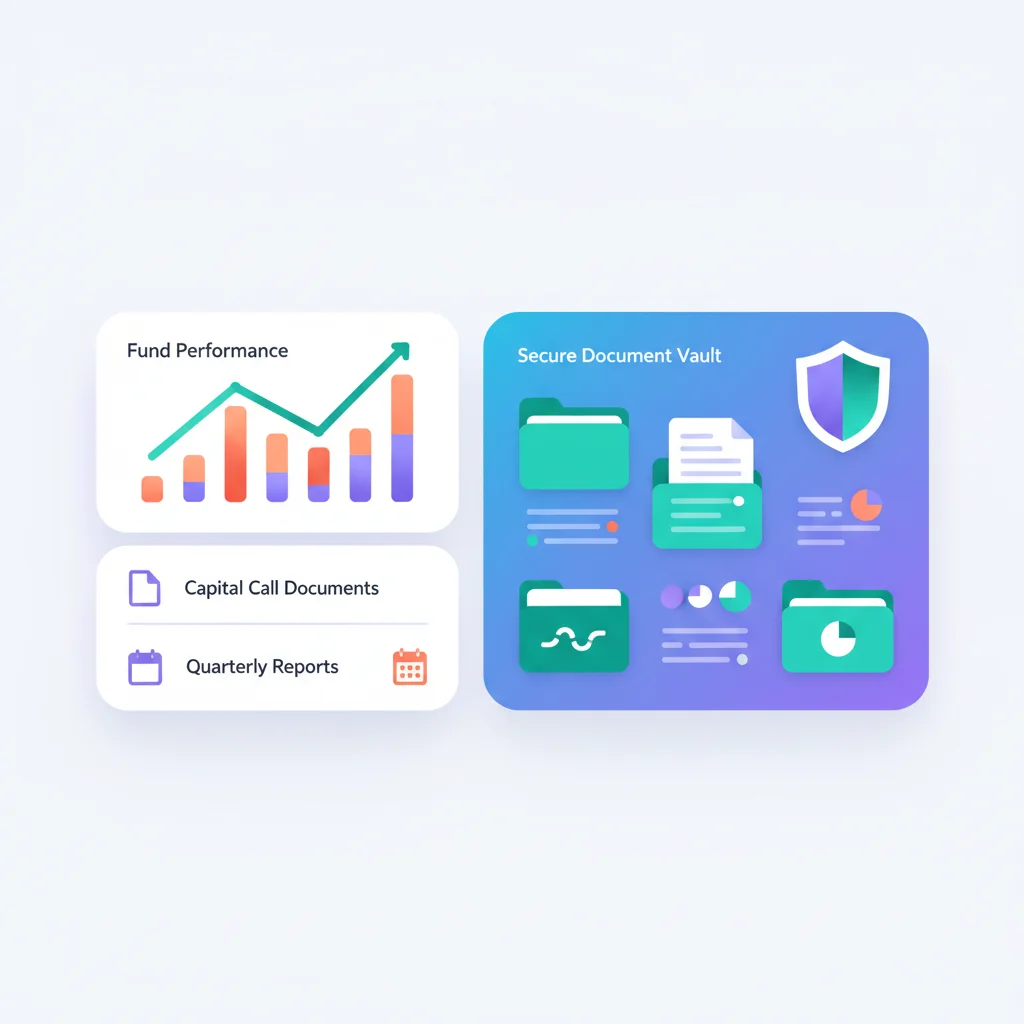
- Property performance dashboards — occupancy, NOI, cap rate, DSCR, projected vs. actual.
- Fund-level performance for multi-property funds — IRR, equity multiple, distributions to date.
- Distribution waterfall display — pref, return of capital, promote, GP/LP splits.
- Document vault — PPMs, subscription documents, operating agreements, K-1s, quarterly reports, property financial statements.
- Capital call and distribution notifications with wire instructions.
- Construction/renovation tracking for value-add and ground-up deals.
- Secure messaging with the GP and IR team.
- Role-based access — distinct views for LPs, IR staff, asset managers, fund accountants.
- Sponsor branding — multi-sponsor platforms must support white-labeling per syndicator.
Real Estate Investor Portal Software
- Juniper Square — The category leader for commercial real estate private equity. Combines investor portal, fund admin, and CRM. Common from emerging managers up to large institutional sponsors.
- InvestNext — Real estate investment management with investor portal. Strong fit for syndicators and small-to-mid-size real estate sponsors.
- Cash Flow Portal — Investor portal aimed at real estate syndicators. Emphasizes ease of setup.
- Syndication Pro — All-in-one CRM and investor portal for real estate syndicators.
- Appfolio Investment Manager — Investor management and portal platform from the Appfolio family, well-suited to firms also using Appfolio property management.
- RealCrowd — Investor portal and capital raising platform with embedded compliance support.
- Groundbreaker — Investor portal and back-office automation for real estate sponsors.
- Yardi Investment Manager — Investor portal as part of the Yardi commercial real estate suite. Common at firms already on Yardi for property management.
- Allvue Systems — Enterprise-grade investor portal as part of a broader alternatives platform; used by larger institutional real estate funds.
What a Real Estate LP Portal Looks Like in Practice
A high-net-worth LP invests in a value-add multifamily syndication — a 120-unit property in Phoenix, $50M deal, three-year hold, 8% pref with 70/30 split above. They log into the sponsor’s portal on a Sunday afternoon. The dashboard shows current occupancy (94%, up from 78% at acquisition), trailing-twelve-month NOI ($3.1M vs. $2.4M underwriting), and a distribution scheduled to hit their bank account next Friday. They click into the property page and see a photo log of the recent unit renovations, the latest rent roll, and the operating budget with actuals year-to-date.
Later, after the property sells, they log in again to find: the final settlement statement, the sale proceeds calculation showing how the waterfall was applied, their final K-1 with depreciation recapture clearly noted, and the GP’s lessons-learned summary. The whole investment experience — from subscription through exit — happened in the portal. The GP fielded maybe ten emails over three years for an LP they otherwise would have been on the phone with quarterly.
For the syndicator, the portal economics work differently than at an institutional fund. The pitch isn’t “we need this for ODD” — it’s “we want to scale to 200 LPs without scaling our IR team to ten people.” That’s possible with a portal. It’s not possible with email and spreadsheets.
Multi-Sponsor vs. Single-Sponsor Portals
Two distinct models exist for real estate investor portals:
- Single-sponsor portal — The portal is branded and operated by one GP. Their LPs log into “their” portal. This is the model for most established sponsors.
- Multi-sponsor / marketplace portal — A platform like CrowdStreet, RealCrowd, or EquityMultiple hosts multiple sponsors’ deals. LPs see a portfolio of investments across different sponsors in one place.
If you’re a sponsor evaluating which way to go, the question is whether you want full brand control (single-sponsor) or distribution help with investor acquisition (multi-sponsor marketplace). Many sponsors do both.
Frequently Asked Questions
Is a real estate LP portal different from a “real estate LP investor portal”?
No — these are the same thing. The phrasing varies in search but the underlying tool is identical: a portal that gives limited partners in real estate funds and syndications self-service access to their investment data.
Do I need a real estate-specific portal, or will a general LP portal work?
General LP portals work for the basics — capital accounts, document delivery, performance. But real-estate-specific portals handle property-level data, waterfall structures, construction tracking, and 1031/OZ workflows out of the box. If you’re a real estate sponsor doing more than the occasional one-off deal, a real-estate-specific portal will save time and look more credible to LPs.
What about 506(c) and accredited investor verification?
For 506(c) offerings (which allow general solicitation), you need to verify investor accreditation. Several portals — including Juniper Square and InvestNext — integrate with third-party accreditation services like VerifyInvestor.com or Parallel Markets to streamline this.
How long does it take to launch a real estate investor portal?
For a syndicator with a small LP base and a clean document set, 4–8 weeks is realistic from kickoff to first LP login on platforms like InvestNext or Juniper Square. Migration of historical capital accounts and K-1s is usually the longest step. Enterprise builds on Allvue or Yardi can take 3–6 months or longer.