Fifty locations, one brand standard — and somehow everyone’s using a different version of the logo. When your franchise network runs on email chains and shared drives, inconsistency isn’t a risk. It’s a guarantee.
A franchise portal gives every franchisee a single hub for brand assets, operations manuals, training, performance data, and communication. Everyone stays on the same page — literally. Whether you call it a franchise portal, franchisee portal, or franchise intranet, the goal is the same: keep your franchise system aligned without burying corporate in support emails. For a deeper look at how franchise networks use portals, see our franchise industry guide.
What Makes Franchise Portals Unique
Unlike a typical customer portal, franchise portals serve an internal business network. Franchisees are both customers (they pay franchise fees) and partners (they represent your brand). This dual relationship requires a portal that balances support with accountability.
Core Capabilities
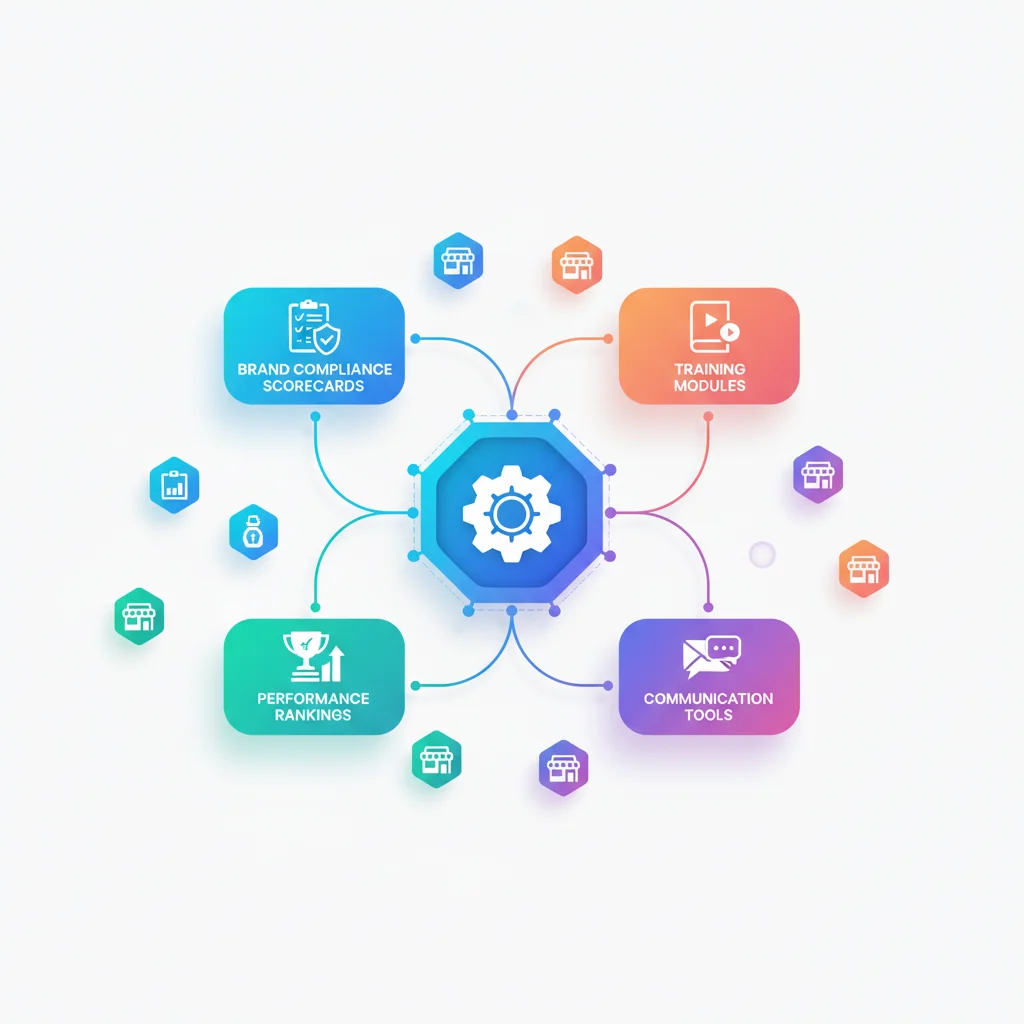
- Operations manual — Digital, searchable, always up-to-date. When procedures change, every franchisee has immediate access.
- Brand asset management — Logos, templates, signage specs, and marketing materials with version control to ensure consistency.
- Training and certification — Onboarding courses, ongoing training modules, and certification tracking for franchisee staff.
- Performance dashboards — Location-level KPIs including sales, customer satisfaction, and compliance scores.
- Communication — Announcements, newsletters, and messaging organized by region, cohort, or topic.
- Vendor and supply chain — Approved vendor lists, ordering links, and supply chain updates.
- Compliance and audits — Store inspection results, corrective action tracking, and compliance documentation.
- New franchisee onboarding — Structured workflows for getting new locations up and running.
Benefits for Franchise Systems
- Brand consistency — When every location has access to the same resources, consistency improves naturally.
- Faster onboarding — New franchisees get productive faster with structured, self-paced onboarding.
- Better communication — Important updates reach everyone, with read-receipt tracking.
- Data-driven management — Performance data helps identify which locations need support.
- Reduced HQ overhead — Self-service access to resources reduces calls and emails to corporate.
Franchise Portal Software
The right franchise portal software depends on the size of your network and how much you need beyond pure communication and document sharing.
- Naranga — Purpose-built franchise management platform with franchisee portal, audit tools, training, royalty management, and lead management. Widely used by emerging and mid-size franchise systems.
- FranConnect — Enterprise franchise management platform covering franchise development, operations, training, performance, and royalty. The dominant platform at larger franchise systems (50+ units).
- Wingmate — Field communication and operations tool used by some franchise networks for daily ops coordination.
- ZenBusiness FranchiseSoft — Franchise CRM and operations platform with a franchisee portal.
- ServiceMinder — Operations platform popular with home-service franchise systems (HVAC, cleaning, lawn care).
- Profit Keeper — Financial benchmarking platform for franchise systems with franchisee-facing dashboards.
- Trainual — Training and SOP platform used by many franchise systems to deliver consistent onboarding and ongoing training.
For smaller or newer franchise systems (under 20 units), general-purpose intranet platforms like Notion, Confluence, or branded portal platforms like Clinked can serve as a low-cost starting franchise portal. The trade-off is that you’ll outgrow the lack of franchise-specific features (royalty tracking, unit-level KPIs, audit workflows) as the system scales.
Franchise portal software selection framework
| Platform category | Best fit | Must verify | Common trade-off |
|---|---|---|---|
| Franchise management suite | Multi-location systems that need royalties, audits and unit KPIs | Accounting integrations, data export, regional permissions | Longer implementation and quote-based pricing |
| Training or SOP platform | Networks prioritizing onboarding and operational consistency | Certification tracking, version control, acknowledgements | Limited financial and franchise-development workflows |
| Branded general-purpose portal | Emerging networks that need documents, messaging and onboarding | Multi-location permissions, search, white-label controls | Franchise-specific reporting may require workarounds |
| Intranet or workspace | Small networks validating the operating model | External-user access, content governance, audit history | Weak unit-level segmentation and workflow automation |
During demos, ask vendors to show one complete scenario: corporate updates an operating procedure, only the affected locations are notified, every franchisee acknowledges it, and corporate can export the audit trail. A generic feature checklist will not reveal whether that workflow is usable.
What a Franchisee Portal Looks Like in Practice
A regional fast-casual restaurant brand with 35 locations rolls out a franchise portal. A new franchisee opening their first store logs in and walks through a structured onboarding checklist: complete the franchisor’s required training modules, sign the operations agreement, order initial equipment from approved vendors, complete the brand-standards quiz, schedule the grand opening visit. Each step is tracked, each completion is timestamped, and corporate sees real-time progress across every store in development.
After opening, the same franchisee uses the portal daily — checking their store’s sales performance against the system benchmark, ordering supplies through the approved vendor catalog, accessing the latest LTO (limited-time offer) marketing assets, and submitting their weekly compliance checklist. When corporate updates the operations manual, every franchisee gets a notification, can see exactly what changed, and is required to acknowledge the change before access continues.
The shift this creates is operational: corporate stops being the bottleneck. Instead of fielding the same operational questions across 35 locations every day, corporate becomes the publisher — answers go into the portal once, and franchisees self-serve. Phone calls and emails to corporate drop dramatically. Training becomes consistent across locations. Brand standards stay in sync because the only place to get assets is the approved portal library.
Franchise Portal vs. Franchisee Portal: Is There a Difference?
In practice, no — these terms are used interchangeably. Franchise portal is the more common phrasing in software marketing; franchisee portal emphasizes the user perspective (the franchisees themselves). Some larger franchise systems distinguish:
- Franchisee portal — The interface franchisees use day-to-day for operations, training, marketing, and reporting.
- Franchisor admin portal — The interface corporate uses to publish content, monitor franchisee performance, and manage the system.
Most modern franchise portal platforms include both as separate views of the same underlying system. International searches sometimes use Franchiseportal (especially in German-speaking markets) — referring to either franchisor-side franchise development directories or franchisee-facing operations portals depending on context.
Frequently Asked Questions
What is a franchise portal?
A franchise portal is a centralized digital platform where a franchise system shares operations manuals, brand assets, training, performance data, and communications with its franchisees. It’s the franchise version of a customer or partner portal — built specifically for the unique franchisor-franchisee relationship.
How is a franchise portal different from a partner portal or reseller portal?
A partner portal typically supports a broad channel ecosystem (resellers, integrators, referral partners) with sales enablement and deal registration. A reseller portal focuses on sales and ordering for channel partners. A franchise portal is purpose-built for the franchise model: franchisees aren’t just selling your product — they are your brand operating under license. The portal therefore emphasizes brand compliance, operational consistency, training, and performance benchmarking in ways partner portals usually don’t.
Do franchisees actually use these portals?
Adoption is a known challenge — franchisees are busy operators, not portal enthusiasts. The pattern that drives adoption: make the portal the only place certain things live. Operations manual, brand assets, mandatory training, performance benchmarks, marketing assets. If those things aren’t anywhere else, franchisees use the portal. See our portal adoption playbook.
Can a small franchise system (under 10 units) justify a franchise portal?
Yes, although the platform choice differs. Below 10 units, a structured Notion workspace or a Clinked portal can deliver 80% of the value at 10% of the cost. The argument for dedicated franchise portal software (Naranga, FranConnect) becomes compelling around 15–25 units when royalty tracking, performance benchmarking, and audit workflows start to matter.
Does a franchise portal handle royalty tracking?
The franchise-specific platforms (Naranga, FranConnect, FranchiseSoft, ServiceMinder) do, yes. General-purpose intranet platforms don’t. If royalty calculation and collection is a meaningful pain point, that’s the strongest argument for a franchise-specific platform.
What about a franchise portal for franchise development (recruiting new franchisees)?
Some franchise systems run a separate franchise-development portal for prospects evaluating buying a franchise — different audience, different content. FranConnect, Naranga, and FranchiseSoft all include franchise-development modules alongside the franchisee operations portal. In some markets (especially Germany), Franchiseportal refers specifically to these directory-style franchise opportunity sites.
What is franchise management software?
Franchise management software is the platform that supports the operational relationship between a franchisor (corporate) and its franchisees (location operators). It typically combines a franchisee-facing portal (operations manual, training, brand assets, performance dashboards) with a franchisor admin portal (royalty tracking, audit management, lead pipeline). Leading platforms include FranConnect, Naranga, FranchiseSoft, and ServiceMinder.
What are the 4 P’s of franchising?
The “4 P’s of franchising” most commonly cited: People (recruiting the right franchisees and training them well), Profit (sustainable unit economics), Process (consistent operations across locations), and Promotion (brand-level marketing that benefits all locations). A franchise portal supports all four — particularly Process (operations manual, training) and Promotion (brand assets, marketing co-op).
What is the 7-day rule for franchise?
The “7-day rule” in US franchising (under the FTC Franchise Rule and state franchise laws) requires that a franchisor deliver the Franchise Disclosure Document (FDD) to a prospective franchisee at least 7 calendar days before the prospect signs any agreement or pays any money. The rule exists to give prospects time to review the disclosures and make an informed decision.